On this page
- Shinkansen Bullet Trains: The Oversized Luggage Reservation System
- City Subways and Local JR Lines: No Rules, But Real Consequences
- Takuhaibin: Japan’s Luggage Forwarding Service
- Coin Lockers: Your Daytime Freedom Solution
- IC Cards in 2026: How to Pay for It All Without a Physical Card
- Domestic Flights and Highway Buses: Baggage Rules You Must Check First
- Taxis and Rental Cars: When Convenience Beats Cost
- 2026 Budget Reality: What Luggage Services Actually Cost
- Common Mistakes Travellers Make With Luggage in Japan
- Frequently Asked Questions
Japan‘s train network is one of the most efficient in the world — until you add a 75-litre suitcase to the equation. In 2026, record numbers of international visitors are arriving with bigger bags, and the gap between expectation and reality is becoming painfully clear. Trains that look roomy in photos are genuinely cramped when you factor in overhead racks built for briefcases and rush-hour carriages packed shoulder to shoulder. If you don’t plan ahead, you’ll spend your first day in Japan red-faced, blocking a Shinkansen aisle, and paying a fine you didn’t know existed. This guide covers everything — rules, services, costs, and the habits that separate prepared travellers from overwhelmed ones.
Shinkansen Bullet Trains: The Oversized Luggage Reservation System
Since May 2020, passengers on the Tokaido, Sanyo, and Kyushu Shinkansen lines — the routes connecting Tokyo, Kyoto, Osaka, Hiroshima, and Fukuoka — must make a reservation if their luggage qualifies as oversized. The rule is still catching visitors off guard in 2026, so understand it clearly before you travel.
What counts as oversized luggage? Any bag where the total sum of length, width, and height falls between 161 cm and 250 cm. Standard carry-on size bags (under 160 cm combined) can go in the overhead rack without any reservation. Luggage exceeding 250 cm in total dimensions, or weighing more than 30 kg, is not permitted on Shinkansen trains at all.
How oversized bags are stored: When you make the reservation, you are assigned a seat directly in front of a dedicated oversized luggage space — typically behind the last row of seats in certain cars. These spots are limited. If you show up with oversized luggage without a reservation and space happens to be free, you will be charged JPY 1,000 on the spot. If there is no space, staff can refuse to carry your bag. This is not a theoretical risk; it happens regularly on busy travel days.
How to reserve: At JR Ticket Offices (Midori no Madoguchi) at major stations, ask specifically for a seat with an “oversized luggage area” (特大荷物スペースつき座席). You can also reserve online through smartEX at https://smart-ex.jp/en/ or JR-WEST’s Online Train Reservation at https://e5489.jr-odekake.net. If you hold a JR Pass, the reservation itself has no extra charge — you are simply selecting the correct seat type. Strollers, musical instruments in cases, and sports equipment like skis and snowboards are generally exempt from this reservation requirement.

City Subways and Local JR Lines: No Rules, But Real Consequences
Tokyo Metro, Toei Subway, Osaka Metro, and JR local lines have no formal luggage reservation system and no additional fees. But “no rules” does not mean “no problem.” The overhead racks on these trains are shallow — designed for a laptop bag, not a 28-inch suitcase. Your large bag will end up on the floor, blocking the aisle or pressing into the legs of the person seated across from you.
The real issue is timing. Tokyo’s morning rush runs roughly 7:00 to 9:30 AM, and the evening peak hits from about 5:00 to 7:00 PM on weekdays. During these windows, carriages on the Yamanote Line and major Osaka subway lines reach a level of crowding that is physically uncomfortable even without luggage. Boarding with a 20 kg suitcase during peak hours is genuinely inconsiderate to other passengers and will make your own journey miserable. Travel between 10:00 AM and 4:00 PM whenever you have large bags, and the same network becomes entirely manageable.
The 250 cm total dimension limit technically applies here too, but enforcement on local lines is informal. What actually happens is that other passengers will be unable to move around you, and the silent social pressure in a Japanese train carriage is considerable. That feeling — the quiet, collective discomfort radiating toward you — is reason enough to rethink your timing or use an alternative service.
Takuhaibin: Japan’s Luggage Forwarding Service
Takuhaibin is the single most useful service for travellers with large bags, and it is dramatically underused by first-time visitors who don’t know it exists. The concept is simple: you send your suitcase ahead to your next hotel, and you travel by train unburdened.
The two main providers are Yamato Transport (Kuroneko Yamato) at https://www.kuronekoyamato.co.jp/en/ and Sagawa Express at https://www.sagawa-exp.co.jp/english/. Drop off your bag at airport counters, hotel front desks, or any 7-Eleven, FamilyMart, or Lawson convenience store. The bag arrives at your destination the following day in most cases — allow two days for remote locations or during peak holiday periods.

In 2026, expect to pay JPY 1,500 to JPY 3,000 per standard suitcase for next-day delivery between major cities. Same-day delivery is available on some routes but costs more and has strict cut-off times. If you are arriving at Narita or Haneda and heading straight to Kyoto for two nights before moving to Tokyo, sending your bag the day before from the airport to the Kyoto hotel means you board the Shinkansen with only a daypack. The cost — around JPY 2,000 — is worth far more in comfort and ease.
Coin Lockers: Your Daytime Freedom Solution
Luggage forwarding works between cities. But what about the day you check out of your Kyoto hotel at 11:00 AM and your Osaka hotel doesn’t allow check-in until 3:00 PM? Coin lockers solve this.
They are available at virtually every JR station, most subway stations, and many bus terminals and tourist attraction entrances. Sizes and current 2026 costs per 24-hour period:
- Small (fits a backpack or carry-on bag): JPY 300–500
- Medium (fits a small suitcase): JPY 500–700
- Large (fits a full-size suitcase): JPY 700–1,000
Modern lockers at major stations like Kyoto, Shinjuku, and Osaka accept IC cards — tap your Suica or PASMO to pay and unlock. Older lockers at smaller stations still require JPY 100 coins, so carry a few. Large lockers disappear quickly at popular stations on weekends and during peak seasons. If you arrive at Kyoto Station at 9:00 AM on a Saturday in cherry blossom season and need a large locker, check the secondary locker banks near the Hachijo exit, not just the main concourse.
IC Cards in 2026: How to Pay for It All Without a Physical Card
Suica, PASMO, and ICOCA are the IC cards that power travel across Japan’s trains, subways, and buses. They also pay for coin lockers, convenience store purchases, and vending machines. In 2026, one critical change from previous years still applies: the physical Suica and PASMO cards for tourists remain largely unavailable due to ongoing semiconductor supply constraints that began in mid-2023.
The solution is the mobile version. Add a Mobile Suica, Mobile PASMO, or Mobile ICOCA directly to Apple Wallet (iOS) or Google Wallet (Android). Open your wallet app, tap the “+” button, select a transit card, and follow the prompts. Top up using a Visa, Mastercard, or American Express card. Minimum top-up is typically JPY 1,000 to JPY 2,000. Unlike physical cards, mobile IC cards require no JPY 500 deposit and can be fully refunded to your linked card through the app.

Useful official links: JR East Suica at https://www.jreast.co.jp/e/suica/ and PASMO at https://www.pasmo.co.jp/en/ and ICOCA at https://www.jr-odekake.net/icoca/en/.
Domestic Flights and Highway Buses: Baggage Rules You Must Check First
For long-distance travel with heavy luggage, domestic flights on ANA (https://www.ana.co.jp/en/jp/) and JAL (https://www.jal.com/en/) typically include one or two checked pieces up to 20–23 kg each in the base fare. Low-cost carriers Peach Aviation (https://www.flypeach.com/en/) and Jetstar Japan (https://www.jetstar.com/jp/en/home) do not include checked luggage — you pay extra, and the difference between booking online in advance versus paying at the airport counter is significant. Online rates for a 10–20 kg bag run around JPY 1,500–4,000 per segment. Airport counter fees jump to JPY 3,000–6,000 for the same bag. Always pre-purchase baggage allowance when booking LCC tickets.
For highway buses through operators like Willer Express (https://willerexpress.com/en/), the undercarriage typically takes one piece of luggage with dimensions up to 100–120 cm total and weight up to 10 kg. This is considerably more restrictive than most travellers expect. If your suitcase exceeds this, you may need to forward it separately via Yamato or Sagawa before the journey.
Taxis and Rental Cars: When Convenience Beats Cost
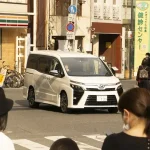
A standard sedan taxi in Tokyo handles two large suitcases comfortably in the boot. Larger minivan taxis — Toyota Alphard and Vellfire models are increasingly available in 2026 — fit four to six large bags. Initial fare is approximately JPY 500 for the first 1.0–1.2 km, then around JPY 100 per 230–280 metres. A 20% late-night surcharge applies between 10:00 PM and 5:00 AM. Use the GO app (https://go.mo-t.com/) or S.RIDE (https://www.sride.jp/en/) to book, specify vehicle type, and pay without cash.
For rural travel — think the Noto Peninsula, the Iya Valley in Shikoku, or Hokkaido’s interior — a rental car is the only practical solution when you have significant luggage. Major companies include Toyota Rent-a-Car (https://rent.toyota.co.jp/eng/), Nissan Rent-a-Car (https://nissan-rentacar.com/english/), and Times Car Rental (https://www.timescar-rental.com/). Small cars run JPY 6,000–8,000 per day, mid-size cars JPY 8,000–12,000. You must carry an International Driving Permit issued under the 1949 Geneva Convention, obtained in your home country before departure.
2026 Budget Reality: What Luggage Services Actually Cost

Here is a clear breakdown of what to budget for luggage-related services in 2026:
- Budget traveller: Coin lockers (JPY 300–700 per day) and self-managed transit during off-peak hours. Total luggage cost: JPY 1,000–3,000 for a week-long trip.
- Mid-range traveller: One or two Takuhaibin forwarding services between cities (JPY 1,500–3,000 per bag per shipment) plus occasional locker use. Total: JPY 4,000–9,000 for a two-week trip with three city changes.
- Comfortable traveller: Regular Takuhaibin forwarding, minivan taxis from airports, and LCC pre-paid baggage on domestic legs. Total: JPY 15,000–25,000 for a multi-city journey, but your travel days are genuinely stress-free.
- Shinkansen oversized luggage fee (no reservation): JPY 1,000 penalty — avoidable with a simple advance reservation.
- LCC airport counter bag fee: JPY 3,000–6,000 — avoidable by booking online.
Common Mistakes Travellers Make With Luggage in Japan
- Ignoring the Shinkansen reservation requirement. The JPY 1,000 fine is the best-case outcome. The worst case is your bag gets refused carriage entirely.
- Boarding city trains during rush hour with a large suitcase. It creates real inconvenience for other passengers and makes your own journey unpleasant.
- Assuming highway buses have generous luggage limits. The 10 kg undercarriage limit catches many travellers completely off guard.
- Not using Takuhaibin because it seems complicated. Every hotel front desk and convenience store handles these shipments daily. The staff are used to helping tourists.
- Waiting too long for a coin locker. Large lockers at famous stations — especially Kyoto and Shinjuku — fill up by mid-morning on busy tourist days. Arrive early or use the forwarding service instead.
- Trying to use a physical IC card that no longer exists for tourists. Set up Mobile Suica or Mobile PASMO before you leave home. It takes ten minutes and saves confusion at the ticket gate.
Frequently Asked Questions
Do I need to pay extra to bring a large suitcase on the Shinkansen?
Not if you reserve in advance. The reservation for an oversized luggage space (for bags with combined dimensions of 161–250 cm) is free. If you bring oversized luggage without a reservation and space is available, you pay JPY 1,000. If no space is available, the bag may be refused. Reserve at the time you book your seat.
Can I take my big suitcase on the Tokyo Metro?
There is no official ban and no fee, but there are size limits (250 cm total, 30 kg maximum) and strong unspoken rules about courtesy. Avoid travelling with large luggage during morning rush (7:00–9:30 AM) and evening rush (5:00–7:00 PM) on weekdays. Off-peak, it is manageable on most lines.

How does Takuhaibin luggage forwarding work for tourists?
Drop your bag at any convenience store, hotel front desk, or airport counter. Fill in a simple form (English versions are available), pay JPY 1,500–3,000 per suitcase, and your bag arrives at your next hotel the following day. Yamato Transport and Sagawa Express are the two main services, both reliable and widely available across Japan.
Are physical Suica cards still available in 2026?
Physical Suica and PASMO cards for tourists remain largely unavailable in 2026 due to ongoing semiconductor supply issues. The recommended solution is Mobile Suica, Mobile PASMO, or Mobile ICOCA, added directly to Apple Wallet or Google Wallet. These work identically to physical cards and require no deposit.
What is the cheapest way to handle luggage between Japanese cities?
Coin lockers (JPY 300–1,000 per day) are the cheapest option for short-term storage within a single city. For moving luggage between cities, Takuhaibin forwarding at JPY 1,500–3,000 per bag is the best value when you factor in the comfort and time saved versus managing large bags on crowded trains.