On this page
- Booking Shinkansen Tickets Step by Step with SmartEX
- The JR Pass in 2026: Is It Still Worth Buying?
- IC Cards in 2026: Getting a Suica Without the Plastic
- Subways in Tokyo and Osaka: Fares, Hours and Day Passes
- JR Local Lines and Highway Buses for Regional Travel
- Flights, Taxis, Rental Cars and Bicycles
- 2026 Transport Budget Reality
- Common Mistakes to Avoid
- Frequently Asked Questions
You land in Japan, walk up to a ticket machine to buy a Suica card, and find it is not for sale. Plenty of visitors hit this wall now, and it is only one of several things that changed after 2024. The JR Pass costs far more than it used to, and the cards that once made travel effortless are harder to get. This guide walks through each transport option in Japan, with the 2026 prices and steps you need to move Around without wasting money or time.
Booking Shinkansen Tickets Step by Step with SmartEX
The Shinkansen is the backbone of long-distance travel in Japan. Lines run under JR East, JR Central, JR West, JR Kyushu and JR Hokkaido, with speeds up to 320 km/h on routes like the Tohoku and Tokaido lines. On the Tokaido Shinkansen between Tokyo and Osaka, a train leaves every 5 to 10 minutes at peak times, so you rarely wait long.
You can buy tickets at JR ticket offices (Midori-no-Madoguchi), at station ticket machines, or online. For the Tokaido and Sanyo Shinkansen, the easiest route is SmartEX:
- Download the SmartEX app or visit smart-ex.jp/en.
- Register an account with a credit card.
- Select your departure and arrival stations, the date and the time.
- Choose a reserved seat (指定席, shitei-seki) or a non-reserved seat (自由席, jiyu-seki). Reserved seats are the safer choice in busy periods. Green Car, the first-class option, is also available.
- Confirm the details and pay.
- Collect physical tickets at a JR station ticket machine or gate using your QR code or registered IC card. You can also scan the QR code directly at the gate.
For other regions, JR East has its own train reservation site, so check which company runs your line before you book.
The JR Pass in 2026: Is It Still Worth Buying?
The Japan Rail Pass is valid on most JR Group trains, including many Shinkansen lines. It is sold only to tourists entering Japan on a “Temporary Visitor” stamp. After a major price increase in October 2023, the current prices are the ones that apply in 2026:
- 7-day Ordinary: ¥50,000
- 14-day Ordinary: ¥80,000
- 21-day Ordinary: ¥100,000
- 7-day Green Car: ¥70,000
- 14-day Green Car: ¥111,000
- 21-day Green Car: ¥140,000
The pass does not cover Nozomi and Mizuho services on the Tokaido and Sanyo Shinkansen, which are the fastest trains. Since October 2023 you can buy a special add-on ticket to ride them. For example, Tokyo to Shin-Osaka on the Nozomi costs about ¥4,960 extra.

To use the pass, exchange your Exchange Order for the actual pass at a designated JR office when you arrive in Japan. Reserve seats at a JR ticket office or ticket machine, especially for long journeys and popular routes. The official site is japanrailpass.net.
At these prices, a short trip with only a Tokyo to Osaka return will often cost less with individual tickets. The pass makes sense when you plan several long rides in a short time, or when you want to use JR local lines freely in a region.
IC Cards in 2026: Getting a Suica Without the Plastic
IC cards are rechargeable contactless cards that work on trains, subways and buses. You can also use them to pay at many convenience stores and shops. The ten major cards are Suica, Pasmo, ICOCA, Kitaca, TOICA, Manaca, Sugoca, Nimoca, Hayakaken and PiTaPa, and they work nationwide. A Suica bought in Tokyo works in Osaka, and an ICOCA works in Tokyo. Each card holds up to ¥20,000.
The problem is supply. A global semiconductor shortage led to the sale of physical Suica and Pasmo cards being suspended or severely limited in many areas since 2023. That includes the tourist versions, Welcome Suica and Pasmo Passport. This situation is likely to continue into 2026.
Mobile Suica on an iPhone
If you have a compatible phone, a mobile card is the easiest fix. This works with an iPhone using Apple Pay, or an Android phone using Google Pay or Osaifu-Keitai. For an iPhone:
- Make sure your iPhone region is set to Japan (temporarily, if needed) or that Apple Pay supports Suica in your region.
- Open the Wallet app.
- Tap the “+” sign to add a new card.
- Select “Transit Card” and choose “Suica” or “PASMO”.
- Create a new card or transfer an existing physical card.
- Load money using Apple Pay with a credit or debit card.
- Hold your phone near the reader at the ticket gate.
The apps are “SuicaEng” for Suica and “PASMO” for Pasmo.
Physical card options
- Welcome Suica (JR East) and Pasmo Passport (Tokyo Metro/Toei): limited tourist cards, valid for 28 days with no deposit. Sold at specific JR Travel Service Centers or subway stations. Check whether sales have fully resumed before you rely on them.
- ICOCA (JR West): regular cards may still be sold at JR West stations in Kansai, such as Kansai Airport. Confirm availability before you travel.
- One-time paper tickets: always an option, though slower.

Subways in Tokyo and Osaka: Fares, Hours and Day Passes
Tokyo has two separate subway networks, Tokyo Metro and Toei Subway. Fares are distance-based, and both start at about ¥180 to ¥220 for adults by cash or IC card. Transfers between the two networks often need a separate fare, or a transfer discount if you pay with an IC card. Trains generally run from 05:00 to 01:00.
If you will ride a lot in one or two days, the Tokyo Subway Ticket gives unlimited rides on both networks. Expected 2026 prices, based on 2024 prices, are:
- 24-hour: ¥800
- 48-hour: ¥1,200
- 72-hour: ¥1,500
Details are at tokyometro.jp/en/ticket/travel. Suica or Pasmo works on both networks if you prefer not to count rides.
Osaka Metro is the main way to get around Osaka. Fares start at about ¥190 to ¥240, and trains generally run from 05:00 to 00:00, an hour earlier than Tokyo’s last runs. The Osaka Amazing Pass covers Osaka Metro, Osaka City Bus and some private railways, plus free entry to over 40 attractions. Expected 2026 prices, based on 2024 prices, are ¥3,300 for one day and ¥4,000 for two days. Information is at osp.osaka-info.jp/en. ICOCA is the local IC card, but Suica and Pasmo work fully there too.
JR Local Lines and Highway Buses for Regional Travel
JR local and rapid trains cover most of Japan. They link suburbs to city centres and reach towns that the Shinkansen skips. The Yamanote Line, the loop around central Tokyo, starts from ¥140. Use an IC card for convenience, or buy paper tickets from vending machines. The JR Pass is valid on almost all JR local lines, which helps if you explore a single region in depth.
For overnight trips, highway buses save you a hotel night. Willer Express is a prominent operator with an English booking site (willerexpress.com/en) and an app called Willer Travel for iOS and Android. Bus types range from standard to relaxation to premium. Many buses have reclining seats, blankets, charging ports and sometimes individual privacy curtains.
A Tokyo to Osaka bus costs ¥4,000 to ¥10,000 depending on bus type, day and how early you book. That is much cheaper than the Shinkansen, but the journey takes far longer.

Flights, Taxis, Rental Cars and Bicycles
Domestic flights
For long distances or remote regions such as Hokkaido and Okinawa, flying can beat the train. The full-service carriers are ANA (ana.co.jp/en/jp) and JAL (jal.com/en). Low-cost options are Peach Aviation (flypeach.com), affiliated with ANA, and Jetstar Japan (jetstar.com/jp/en/home), affiliated with JAL and Qantas. Fares vary widely, from ¥5,000 on short LCC routes to ¥30,000 or more on full-service long routes, so book early.
ANA and JAL both sell special fares for international tourists, such as the ANA Japan Explorer Pass and the JAL Japan Explorer Pass. Expected 2026 prices, based on 2024, are ¥5,500 to ¥11,000 per flight segment. You must hold a non-Japanese passport and live outside Japan, and you book only on the airline’s international website. Each airline also has its own app.
Taxis
Taxis suit short hops, late nights and heavy luggage. In Tokyo’s 23 wards, expect a base fare of about ¥500 to ¥550 for the first 1.0 km, then about ¥100 for every additional 250 to 280 metres. A 20% surcharge typically applies from 22:00 to 05:00. You pay any highway tolls. Most taxis accept cash and credit cards, and more take IC cards and mobile payments such as PayPay.
Hail one with Go Taxi (go.goinc.jp) or S.RIDE (sride.jp/en), which is popular in Tokyo. Do not open the rear door, because the driver opens it automatically. Tipping is not customary.
Rental cars
A car makes sense in rural areas with thin public transport. You need an International Driving Permit under the 1949 Geneva Convention, issued in your home country, and you must carry it with your original licence and passport. A credit card is needed for payment and the deposit. Major companies include Toyota Rent-a-Car (rent.toyota.co.jp/eng), Nissan Rent-a-Car (nissan-rentacar.com/english) and Times Car Rental (timescar-rental.com), along with Budget, Hertz, Orix and Nippon Rent-A-Car.
Expect ¥6,000 to ¥10,000 per day for a compact car and ¥10,000 to ¥18,000 for a mid-size car or SUV. Basic insurance is included. Extra non-operation charge waiver cover costs ¥1,000 to ¥2,000 per day and is worth taking. An ETC card for toll roads costs about ¥330 per day when rented with the car, or is sometimes free, and tolls are charged separately. Cars usually have English GPS, and Google Maps works well too.

Cycling in Kyoto
Kyoto’s mostly flat ground and narrow streets suit bicycles. Shops cluster near Kyoto Station and tourist areas. Options include Kyoto Cycling Tour Project (KCTP), J-Cycle and Cycle Terminal, and many hotels rent bikes too.
Expect ¥1,000 to ¥1,500 per day for a basic city bike and ¥1,800 to ¥2,500 for an electric-assist bike, which is highly recommended for longer distances or slight slopes. Multi-day rentals are often discounted. Follow the rules:
- Ride on the left side of the road.
- Pedestrians have priority, so take great care on shared paths and sidewalks.
- Never ride after drinking alcohol.
- Park only in designated areas, because illegal parking can bring fines or impoundment.
- Use front and rear lights at night.
2026 Transport Budget Reality
These figures use the prices above. Many are estimates based on 2024 and 2023 data, so treat them as planning guides.
- Budget: Tokyo Subway Ticket at ¥800 for 24 hours, a basic Kyoto bike at ¥1,000 to ¥1,500 per day, and an overnight Willer bus between Tokyo and Osaka at the lower end of ¥4,000 to ¥10,000. Add LCC flights from ¥5,000 on short routes.
- Mid-range: a 7-day Ordinary JR Pass at ¥50,000 if your itinerary justifies it, an Osaka Amazing Pass at ¥3,300 for one day, a Nozomi add-on at about ¥4,960, an electric Kyoto bike at ¥1,800 to ¥2,500, and a tourist-fare flight at ¥5,500 to ¥11,000.
- Comfortable: a 7-day Green Car Pass at ¥70,000, or a 14-day one at ¥111,000, plus regular taxis, a mid-size rental car at ¥10,000 to ¥18,000 per day, and full-service flights up to ¥30,000 or more.
Common Mistakes to Avoid
- Counting on buying a plastic Suica at the airport. Set up mobile Suica before you fly, or have a backup plan with paper tickets.
- Buying the JR Pass without doing the maths. At ¥50,000 for seven days, it only pays off with several long rides.
- Expecting the pass to cover the Nozomi. It does not, unless you pay the add-on fee.
- Skipping seat reservations. Non-reserved cars can be full on busy routes and holidays.
- Forgetting your International Driving Permit. Without it, and your original licence and passport, you cannot rent a car.
- Ignoring the taxi night surcharge. The 20% extra from 22:00 to 05:00 adds up on long rides.
- Cycling casually on sidewalks. Pedestrians come first, and parking in the wrong place risks a fine or impoundment.
Frequently Asked Questions
Can tourists still buy a Suica card in 2026?
Availability is limited. Sales of physical Suica and Pasmo cards, including Welcome Suica and Pasmo Passport, have been suspended or restricted since 2023, and that is likely to continue. The most reliable option is mobile Suica or Pasmo through Apple Pay or Google Pay.

How much does the JR Pass cost in 2026?
Ordinary passes cost ¥50,000 for 7 days, ¥80,000 for 14 days and ¥100,000 for 21 days. Green Car passes cost ¥70,000, ¥111,000 and ¥140,000. These prices follow the October 2023 increase and are fully in effect now.
Does the JR Pass cover the Nozomi Shinkansen?
Not by default. Nozomi and Mizuho services are excluded, but since October 2023 pass holders can buy an add-on ticket to ride them. Tokyo to Shin-Osaka on the Nozomi costs about ¥4,960 extra. Otherwise, take the covered Hikari or Kodama trains.
Do I need an International Driving Permit to rent a car in Japan?
Yes, for most nationalities. The permit must be issued in your home country under the 1949 Geneva Convention. You need to carry it with your original driving licence and passport. You also need a credit card for payment and the rental deposit.
Is tipping expected in Japanese taxis?
No, tipping is not customary in Japan. Pay the metered fare, plus any highway tolls and the 20% late-night surcharge between 22:00 and 05:00 if it applies. The rear door opens automatically, so do not touch it yourself.
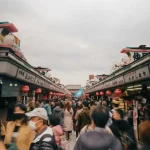
📷 Featured image by Victoriano Izquierdo on Unsplash.