On this page
- Why Osaka Still Earns Its “Japan’s Kitchen” Reputation in 2026
- Takoyaki: Finding the Real Thing in a Sea of Tourist Copies
- Okonomiyaki: The Osaka Version Has Its Own Rules
- Kushikatsu: Deep-Fried Skewers and the One Rule You Cannot Break
- Ramen and Udon: Osaka’s Quieter Noodle Scene
- Depachika and Kuromon Market: Grazing Your Way Through Osaka’s Food Halls
- Hozenji Yokocho and the Dotonbori Back Alleys: Eating With Atmosphere
- Osaka Breakfast: The Morning Meal Most Visitors Sleep Through
- Street Food Beyond the Big Three: Lesser-Known Bites Worth Hunting Down
- 2026 Budget Breakdown: What Eating in Osaka Actually Costs
- Practical Tips for Eating Through Osaka Without Friction
- Frequently Asked Questions
💰 Click here to see Japan Budget Breakdown
💰 Prices updated: October, 2026. Budget figures are estimates — always verify before travel.
Exchange Rate: $1 USD = ¥157.00
Daily Budget (per person)
Shoestring: ¥8,000 – ¥15,000 ($50.96 – $95.54)
Mid-range: ¥18,000 – ¥35,000 ($114.65 – $222.93)
Comfortable: ¥45,000 – ¥80,000 ($286.62 – $509.55)
Accommodation (per night)
Hostel/guesthouse: ¥2,500 – ¥6,000 ($15.92 – $38.22)
Mid-range hotel: ¥10,000 – ¥20,000 ($63.69 – $127.39)
Food (per meal)
Budget meal: ¥800.00 ($5.10)
Mid-range meal: ¥2,500.00 ($15.92)
Upscale meal: ¥20,000.00 ($127.39)
Transport
Single metro/bus trip: ¥250.00 ($1.59)
Monthly transport pass: ¥30,000.00 ($191.08)
Why Osaka Still Earns Its “Japan’s Kitchen” Reputation in 2026
Osaka in 2026 is crowded. The city’s tourism numbers hit a post-pandemic peak last year and have barely eased since. Dotonbori on a Saturday evening can feel more like a theme park queue than a riverside dining experience. That’s the honest truth. But here’s what most visitors get wrong: they stay on the main drag, photograph the Glico man, and leave thinking they’ve eaten Osaka. They haven’t even scratched the surface. The city’s food culture runs deep into its side streets, covered market arcades, morning rice counters, and standing-only kushikatsu bars that don’t bother with English menus because they don’t need to. This guide cuts past the neon and gets into the food itself — what to eat, exactly where to eat it, and what a realistic food-focused trip costs in 2026.
Takoyaki: Finding the Real Thing in a Sea of Tourist Copies
Osaka’s most iconic street food is a golf ball-sized sphere of wheat batter, filled with a chunk of octopus, pickled ginger, and tenkasu (tempura scraps), cooked in a dimpled iron pan until the outside is crisp and the inside stays molten. You already know what takoyaki is. What you might not know is how dramatically the quality varies across the city.
The most photographed takoyaki stalls along Dotonbori — the ones with the giant animatronic octopus arms — are trading on spectacle. The batter is often pre-mixed and batch-cooked. The queue is real but the product is mediocre. Meanwhile, a 10-minute walk south toward Namba’s back streets, or north into Tenjinbashisuji shopping arcade, and you’ll find small operators cooking to order over seasoned cast iron they’ve used for decades.
Takoyaki-Wanaka near Namba has a cult following among locals — the balls are served in a small tray, glossy with okonomiyaki sauce and mayonnaise, topped with katsuobushi that waves in the steam rising from the molten core. The wait is around 10 minutes for a fresh batch and the price sits around ¥700–¥900 for six pieces in 2026. Takoyaki Juhachiban in the Tenjinbashisuji covered arcade is another consistent pick — the oil ratio in the batter is higher than most, giving you that crackle-then-give texture that defines a well-made ball.
The etiquette: eat immediately. Takoyaki waits for no one. The batter continues cooking in its own residual heat and the texture degrades fast. Burn your mouth slightly. It’s part of the experience.
Okonomiyaki: The Osaka Version Has Its Own Rules
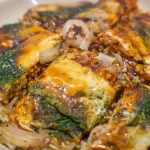
Osaka-style okonomiyaki is not the same as Hiroshima-style and locals will make sure you know it. In Osaka, the ingredients — shredded cabbage, tenkasu, beni shoga (red pickled ginger), pork belly, egg, and batter — are all mixed together before hitting the griddle. The result is a thick, round pancake that’s cooked on both sides and finished with a layered topping of okonomiyaki sauce, Japanese mayo, aonori (dried seaweed flakes), and katsuobushi.
The best way to eat it is at a teppan restaurant where the griddle is built into your table and the cook either prepares it for you or hands you the tools and talks you through it. Mizuno in Namba has been doing this since 1945. It’s not cheap (around ¥1,500–¥2,000 per pancake) and there’s usually a line on weekends, but the yam-enriched batter gives it a lightness you don’t find at cheaper competitors. Arrive at opening — 11:30am — and the wait is manageable.
For something less formal, the Tenjinbashisuji shotengai (Japan’s longest covered shopping street, stretching 2.6 kilometres north from Tenjinbashi) has several small okonomiyaki counters where ¥900–¥1,200 gets you a full pancake with a beer-can-sized Asahi on the side.

One thing to watch: some restaurants serve monjayaki alongside okonomiyaki. It’s a Tokyo thing, thinner and wetter in texture. Not bad, but if you’re in Osaka specifically for the okonomiyaki experience, confirm what you’re ordering.
Kushikatsu: Deep-Fried Skewers and the One Rule You Cannot Break
Kushikatsu is Osaka’s deep-fried skewer culture, and it lives most authentically in the Shinsekai district — a working-class neighbourhood south of Namba that feels genuinely unreconstructed compared to the rest of the tourist belt. The concept is simple: proteins and vegetables (pork, shrimp, lotus root, quail egg, asparagus, cheese) are skewered, coated in fine panko breadcrumbs, and fried in clean oil until golden.
Each skewer costs roughly ¥100–¥300 depending on the ingredient. You order by pointing, or in better places, by ticking boxes on a paper menu. The dipping sauce — a communal pot of Worcestershire-style brown sauce — sits at every table. The rule, displayed on signs in most kushikatsu restaurants, is absolute: no double-dipping. You get one dip. If you want more sauce, use the cabbage leaf provided as a ladle. Violating this gets you a firm correction from staff and disapproving looks from neighboring tables.
Daruma is the most famous kushikatsu chain in Shinsekai and operates several locations around Osaka — consistent, tourist-friendly, and busy. For a more local feel, walk a block or two off the Shinsekai main strip and find a counter-seat shop with a handwritten menu board and a TV playing baseball. The oil quality at smaller shops is often better maintained than at the high-volume tourist operations.
A satisfying kushikatsu session — 8 to 12 skewers with a beer — typically runs ¥1,500–¥2,500 per person in 2026.

Ramen and Udon: Osaka’s Quieter Noodle Scene
Osaka doesn’t carry the ramen reputation of Fukuoka or Sapporo, which means the best shops here have lower profiles and shorter queues. The city’s dominant ramen style leans toward a lighter, soy-based broth — closer to what you’d find in Tokyo than the heavy tonkotsu of Kyushu. That said, there are tonkotsu operators in Osaka doing exceptional work, particularly around the Fukushima district northwest of the city center.
Kinryu Ramen on Dotonbori is a 24-hour institution — the dragon-adorned facade is hard to miss and the tonkotsu broth has a depth that surprises people who write off the location as a tourist spot. At ¥900–¥1,100 a bowl, it’s also one of the better-value meals near the canal. Go after midnight when the tourist crowd thins and the atmosphere shifts entirely.
For udon, Osaka’s proximity to the wheat-belt traditions of the Sanuki (Kagawa Prefecture) style means you’ll find excellent thick, chewy noodles in clear dashi broth across the city. Dotonbori Imai has been serving udon in the neighborhood since 1946. The broth is made from konbu seaweed sourced from Hokkaido — lighter in color than Tokyo broths, sweeter in flavor. A basic kake udon (plain noodle in broth) runs around ¥750. A tempura udon tops out around ¥1,400.
The standing udon counters (tachi-gui udon) inside Osaka’s train stations are worth knowing about too. Platforms at Osaka Station and Namba Station both have counter-service udon stalls that serve bowls in under three minutes for ¥500–¥700. They’re not destination dining, but they’re fast, hot, and entirely authentic.
Depachika and Kuromon Market: Grazing Your Way Through Osaka’s Food Halls
Osaka’s department store basement food halls — depachika — are a category of experience that has no real Western equivalent. The basement floors of Takashimaya and Daimaru in Namba, and Hankyu and Hanshin in Umeda, are stocked with prepared foods, wagashi sweets, bento boxes, sushi counters, bakeries, and regional specialty producers. You don’t need to buy an entire box of anything. Many counters sell individual pieces.

Walk through the Hankyu depachika around 5pm on a weekday and you’ll find the prepared food counters starting to discount — a tray of premium sushi reduced from ¥2,800 to ¥1,600, a box of fried chicken for ¥600. The smell of dashi and freshly fried things drifts down the escalator from the street level. It’s one of the more sensory-rich food environments in the city.
Kuromon Ichiba — the Kuromon Market — is Osaka’s oldest public market, a 580-metre covered arcade near Namba with around 150 stalls. In 2026, it’s busier with tourists than it was five years ago, but the core produce and seafood vendors remain legitimate. Crab legs, fresh tuna, grilled scallops on the half-shell (around ¥400–¥600 each), tamagoyaki rolled at the counter, sea urchin on a spoon. Most stalls are set up for eat-as-you-walk consumption. Budget ¥2,000–¥3,500 for a serious graze through the full length of the market.
Note: Kuromon is busiest from 9am to 1pm. By mid-afternoon, some vendors start breaking down. Arrive before 11am for the best selection.
Hozenji Yokocho and the Dotonbori Back Alleys: Eating With Atmosphere
Running parallel to the Dotonbori canal is a network of narrow lanes that most visitors walk past without realizing what’s there. Hozenji Yokocho — the lantern-lit alley adjacent to the moss-covered Fudo Myo-o statue at Hozenji Temple — is probably the most atmospheric dining street in Osaka. The stone paving is worn smooth, the paper lanterns cast everything in amber, and the restaurants here are small, mostly counter-seat operations that have been running for 30 to 50 years.
You’re not going to find an English menu in most of these places. That’s the point. A Google Translate camera scan gets you through the menu in 30 seconds and the result — whether it’s grilled skewers, cold tofu with yuzu miso, or a small kaiseki-style set dinner — is almost always worth it. Prices range from ¥3,000 to ¥8,000 per person for dinner with drinks, depending on how far into the menu you go.

The streets immediately behind the Dotonbori entertainment strip — particularly around Soemoncho and Higashi-Shinsaibashi — have a denser concentration of izakayas, yakitori counters, and casual Japanese gastropubs than almost anywhere else in the city. These are where Osaka’s nighttime food culture actually lives. Wander in, look through the curtain (noren), check if there’s a seat at the counter, and sit down. That’s the whole method.
Osaka Breakfast: The Morning Meal Most Visitors Sleep Through
Osaka has a tradition of morning sets — coffee shops (kissaten) that serve a full small breakfast bundled with a coffee for ¥500–¥800. You get a hard-boiled egg, small salad, toast or a bread roll, and a bottomless coffee refill. Hoshino Coffee runs a reliable morning set across multiple Osaka locations. But the more interesting spots are the independent kissaten in Shinsaibashi and around Nakamichi — shops that haven’t changed their interior design since the 1980s, where the toast is thick-cut shokupan (Japanese milk bread) and the coffee is hand-dripped.
For something more savory, several old-school rice counters around Nipponbashi and Tennoji open at 7am and serve a teishoku set — grilled fish, miso soup, pickles, and rice — for ¥650–¥950. These aren’t listed on major travel sites. They’re frequented by construction workers, early-shift taxi drivers, and the occasional food-obsessed traveler who did their homework.
The Tsuruhashi area — Osaka’s Koreatown — also has morning-open tabletop yakiniku restaurants. Starting the day with Korean barbecue at 8am is unusual but entirely possible, and the kimchi alone at Tsuruhashi’s market stalls (¥300–¥600 for a small tub) is worth the train ride on the Osaka Loop Line.

Street Food Beyond the Big Three: Lesser-Known Bites Worth Hunting Down
Osaka’s street food conversation starts and ends with takoyaki, okonomiyaki, and kushikatsu for most visitors. That leaves several genuinely excellent things untried.
- Ikayaki — a grilled squid flattened and pressed on a griddle, served wrapped in a paper sleeve. Often found at festivals and in Tenjinbashisuji, around ¥400–¥600. Chewier than takoyaki, smokier, with a strong umami hit from the soy baste.
- Butaman — steamed pork buns sold at the 551 Horai chain, which is something close to an Osaka institution. The stores in Namba and Shinsaibashi often have short queues. Two buns for around ¥420. The filling is dense, slightly sweet, and juicy in a way that the convenience store versions simply aren’t.
- Negiyaki — a green onion-heavy variation of okonomiyaki, thinner and more crêpe-like. Less common than its cousin but worth ordering if you see it on a teppan menu. Often ¥100–¥300 cheaper than a full okonomiyaki.
- Yakiniku at Tsuruhashi — the covered market lanes around Tsuruhashi Station have raw meat vendors and small charcoal grill restaurants clustered so tightly that the smoke from a dozen grills merges into one permanent haze. Lunch sets for two people with kalbi, harami, and rice run ¥3,000–¥4,500.
- Kitsune Udon to go — the sweetened fried tofu (aburaage) on top of a bowl of udon is an Osaka invention. Getting it as takeaway from a covered market stall and eating it on a bench outside is the most Osaka thing you can do for under ¥800.
2026 Budget Breakdown: What Eating in Osaka Actually Costs
Food costs in Osaka have increased noticeably since 2024, driven by a weak yen stabilizing at a slightly stronger level than its 2023 lows, combined with ongoing domestic food inflation. Expect to pay roughly 10–15% more than pre-2024 estimates you might find on older travel blogs.

Budget Tier (under ¥3,000/day on food)
- Breakfast: kissaten morning set — ¥600
- Lunch: station udon or convenience store bento — ¥500–¥750
- Snacks: 6-piece takoyaki + one butaman — ¥1,100–¥1,400
- Dinner: kushikatsu (8 skewers) in Shinsekai with one beer — ¥1,500–¥1,800
- Daily total: approximately ¥2,800–¥4,000
Mid-Range Tier (¥5,000–¥9,000/day on food)
- Breakfast: full teishoku set at a rice counter — ¥800–¥950
- Lunch: okonomiyaki at a sit-down teppan restaurant — ¥1,500–¥2,000
- Kuromon Market graze (mid-afternoon): ¥2,000–¥3,000
- Dinner: izakaya in Hozenji Yokocho with drinks — ¥3,500–¥5,000
- Daily total: approximately ¥7,500–¥11,000
Comfortable/Splurge Tier (¥12,000+/day on food)
- Breakfast: hotel or high-end bakery — ¥1,500–¥2,500
- Lunch: premium kaiseki lunch course — ¥5,000–¥10,000
- Depachika premium sushi or prepared foods — ¥3,000–¥5,000
- Dinner: counter-seat kappo restaurant in Kitahama or Fukushima — ¥12,000–¥20,000 with sake pairing
- Daily total: approximately ¥20,000–¥35,000
One consistent advantage Osaka has over Tokyo in 2026: the mid-range tier delivers significantly better value. A ¥7,000 day of eating in Osaka will outperform the equivalent in Tokyo almost every time.
Practical Tips for Eating Through Osaka Without Friction
A few things that will save you time, money, and awkward moments:
- IC card payments — your Suica or ICOCA card (loaded via the transit app or at station machines) is now accepted at most depachika food counters, convenience stores, and a growing number of market stalls. Cash is still king at Kuromon Market and small yokocho restaurants. Carry ¥3,000–¥5,000 in cash at all times.
- No-reservation culture — most of Osaka’s casual food spots don’t take reservations and don’t need to. Queuing is normal and efficient. For high-end kappo or kaiseki counters, reservations are essential and often require a Japanese phone number. Use a booking service like Tableall or Omakase in 2026 — both now handle international card deposits.
- Standing bars and counters — tachinomi (standing drinking) spots are concentrated around Namba Station’s underground exits and along the Shinsekai main strip. A glass of draft beer or small-pour sake at a standing counter costs ¥350–¥600 and the turnover is fast. No awkwardness about taking a table for one drink.
- Google Maps accuracy — Osaka’s restaurant scene sees significant turnover. In 2026, Google Maps Japan has improved its real-time operational status updates, but smaller family-run spots in yokocho alleys sometimes close unannounced for a week. Check the map’s “hours” section the day before and cross-reference with Tabelog (Japan’s main restaurant review platform) for recent visitor comments.
- Lunch is the budget window — restaurants that serve ¥8,000 kaiseki dinners often offer ¥2,500–¥3,500 lunch sets with the same kitchen quality. In Osaka’s Kitahama and Fukushima districts, lunch at a counter-seat restaurant gives you access to chefs and cooking that would cost three times as much in the evening.
- Allergy communication — as of 2026, most medium-to-large restaurants in Osaka have allergy information cards available in English, Korean, and Chinese following updated hospitality guidelines ahead of Expo 2025 and its continued legacy effect. Smaller counters and market stalls may not. The word for allergy in Japanese is arerugi (アレルギー) and showing a printed allergy card in Japanese gets results faster than trying to explain verbally.

Frequently Asked Questions
What is Osaka’s most famous food?
Takoyaki (octopus balls) is the dish most associated with Osaka internationally, but locals would argue that okonomiyaki and kushikatsu are equally central to the city’s identity. All three are worth eating. If you only have time for one, takoyaki from a quality counter-seat shop in Namba or Tenjinbashisuji is the most distinctly Osaka experience you can have for under ¥1,000.
Is Osaka more affordable for food than Tokyo in 2026?
Yes, noticeably so at the mid-range level. Comparable quality meals in Osaka typically run 15–25% cheaper than Tokyo equivalents. The budget tier is competitive in both cities, but Osaka’s casual dining culture — kushikatsu counters, standing udon bars, covered market stalls — gives budget travelers more variety without sacrificing quality.

Do Osaka restaurants accept credit cards?
More than they did in 2024, but cash is still essential for street food, markets, and small yokocho restaurants. Major depachika food halls, chain restaurants, and higher-end dining spots accept Visa and Mastercard. IC cards (Suica/ICOCA) are increasingly accepted at food counters inside department stores and train stations. Carry ¥5,000 in cash as a baseline.
What area of Osaka has the best food?
Namba and Dotonbori have the highest concentration of eating options, but the side streets around Hozenji Yokocho and Soemoncho deliver better atmosphere and more authentic experiences. The Fukushima district northwest of Osaka Station has become a genuine dining destination in 2026, with a concentration of chef-owned counter restaurants in the streets directly north of Fukushima Station.
When is the best time to visit Osaka for food festivals and events?
October is widely considered the best month — temperatures drop to 18–22°C, the summer humidity is gone, and Osaka’s autumn food festivals (including the Tenjin Matsuri aftermath events and several neighborhood food markets in Nakatsu and Fukushima) are running. The Kuromon Market area also hosts weekend outdoor food events in October and November. Spring (late March to early April) is beautiful for eating outdoors around Osaka Castle Park but coincides with peak tourist crowds.
Explore more
Dotonbori Food Guide: What to Eat & Where in Osaka’s Neon Heart
Nara Day Trip from Osaka: Meet the Famous Deer and Explore Ancient Temples
📷 Featured image by Richard Tao on Unsplash.