On this page
- The Bow: Japan’s Most Misunderstood Greeting
- Wa: The Logic of Social Harmony
- Temple and Shrine Etiquette: Getting the Rituals Right
- Meal Etiquette: From the First Word to the Last Bite
- Public Space Behaviour: The Unwritten Contract
- Onsen and Sentō: Bathing Culture Done Right
- Gift-Giving: The Ritual Matters as Much as the Gift
- 2026 Budget Reality: The Social Cost of Getting It Wrong
- Frequently Asked Questions
Japan welcomed a record number of foreign visitors in 2025, and the tourism surge has continued into 2026 — which means Japanese locals are more accustomed to confused tourists than ever before. That’s both good news and a reason not to get complacent. More visitors also means more visible Etiquette failures, and while Japanese people are genuinely forgiving of honest mistakes, understanding the social logic behind local customs will make your trip fundamentally different. Not just smoother — actually richer. The rules here aren’t arbitrary. They reflect a coherent set of values that, once you understand them, make Japan feel less foreign and more legible.
The Bow: Japan’s Most Misunderstood Greeting
The bow — ojigi in Japanese — is not one gesture. It’s a whole vocabulary. The angle, duration, and context all carry meaning, and getting it roughly right signals that you’ve put in genuine effort to understand Japanese culture.
A casual 15-degree nod is appropriate for everyday acknowledgements: thanking a convenience store clerk, greeting a hotel receptionist, or acknowledging someone who holds a door. It’s quick, informal, and very common. A 30-degree bow is the standard polite greeting — what you’d use when meeting someone for the first time in a professional or semi-formal context, thanking someone sincerely, or greeting a host at a ryokan. A 45-degree bow (head nearly level with the waist) signals deep respect or genuine apology. You’ll see service staff in department stores bowing at this angle, and it would be appropriate if you’ve caused a serious inconvenience.
As a foreign visitor, no one expects you to perfect the gradations. A sincere 30-degree bow paired with eye contact and a genuine expression communicates everything. What to avoid: bowing repeatedly in a loop (which can happen awkwardly when two people keep mirroring each other), and the instinct to extend a handshake simultaneously with a bow. Handshakes do happen in Japan — especially in international business contexts — but let the Japanese person initiate it. If they bow, you bow back.

One practical note: in crowded situations — on trains, in markets — a small nod and a polite step back serves the same social function as a bow. The bow is fundamentally about acknowledging another person’s presence and showing regard. Keep that intention in mind and the mechanics follow naturally.
Wa: The Logic of Social Harmony
Wa (和) translates as harmony, but it operates more like a social operating system. It’s the reason Japanese people rarely say a direct “no,” why a shop assistant might say “it would be a little difficult” when they mean “that’s impossible,” and why public arguments are almost never witnessed even in stressful situations.
The key principle is that maintaining group harmony matters more than individual self-expression in most public contexts. This isn’t passivity — it’s active, skilled social management. When a Japanese person gives you an indirect answer, or seems to be hedging, they are often trying to preserve your dignity while also being honest. “It might be difficult” means no. “I will consider it” often means no. “That would be a little…” followed by a pause means no. Learning to read these softer signals will save you from the social awkwardness of pressing someone who is already trying to decline politely.
For travellers, the most practical application of understanding wa is this: when something goes wrong — a booking error, a miscommunication, a missed train — stay calm and speak quietly. Raising your voice, expressing frustration visibly, or demanding immediate solutions puts everyone in an uncomfortable position and rarely speeds things up. A calm, apologetic tone (even if you’re not in the wrong) keeps the interaction cooperative and usually gets problems resolved faster.

Japanese people will often go to considerable lengths to help a foreign visitor who approaches them respectfully. That generosity is genuine — and it’s much more available to travellers who aren’t visibly agitated.
Temple and Shrine Etiquette: Getting the Rituals Right
Japan has tens of thousands of temples (Buddhist) and shrines (Shinto), and most are open to visitors regardless of religious background. The etiquette differs slightly between the two, and both differ from what most Westerners expect from a “tourist site.”
At a Shinto shrine, start at the torii gate — the distinctive vermilion or stone archway at the entrance. Bow once before passing through. The torii marks the boundary between the everyday world and sacred space; acknowledging it matters. Walk along the side of the path, not the centre, which is traditionally reserved for the deity. At the temizu-ya (the stone basin near the entrance), purify your hands: take the ladle with your right hand, pour water over your left hand, transfer the ladle to your left hand and pour over your right, then cup your right hand to catch water and rinse your mouth (don’t put the ladle to your lips), then let the remaining water run down the handle as you hold it vertically. This is temizu (hand purification), and even if it feels unfamiliar, participating shows respect.
At the main hall (haiden), the standard prayer sequence is: toss a coin into the offering box (any denomination — there’s no rule on amount), bow twice deeply, clap twice, then bow once more. This is called nirei nihakushu ichirei. Some shrines vary slightly, but this pattern works almost universally.
At a Buddhist temple, the approach is quieter. There is no clapping. Incense burning is common — if there’s a large incense burner (kōro), you can purchase incense sticks, light them, and waft the smoke toward yourself, as the smoke is believed to have purifying and healing properties. At some temples you remove shoes before entering the main hall; look for others doing so, or check for a genkan (raised step at the entrance) which signals shoes-off.
Photography rules vary significantly. Some temples and shrines allow photos everywhere; others prohibit them inside buildings or near specific sacred objects. Look for signs, and if you’re unsure, put the camera away in the main hall. Photographing people in prayer without permission is always inappropriate.
Meal Etiquette: From the First Word to the Last Bite
Japanese dining culture has its own rhythms, and most of the “rules” are less about rigid protocol and more about showing awareness of the food and the people around you.
Before eating, say itadakimasu (ee-tah-dah-kee-mah-su) — it loosely translates as “I humbly receive” and is directed at everyone at the table, the person who cooked the meal, and implicitly, the lives of the ingredients. It’s a brief, genuine gesture, not a formal ceremony. At the end of the meal, say gochisousama deshita (go-chee-so-sa-ma deh-shta) — “it was a feast.” Both phrases are deeply appreciated, and using them marks you immediately as someone who has bothered to engage with Japanese culture rather than merely consume it.
Chopstick rules matter more than most guides suggest. The two firm prohibitions: never stick chopsticks upright into a bowl of rice (this mimics incense sticks at funerals — it’s a death association), and never pass food directly from chopstick to chopstick (another funeral ritual). If you’re sharing food from a communal dish, use the clean end of your chopsticks or the serving utensils provided. Resting chopsticks on the edge of your bowl or on the chopstick rest (hashioki) provided is perfectly fine.

Slurping noodles — ramen, soba, udon — is not only acceptable but actively signals enjoyment. The sound is associated with good taste and appreciation for the cook. Don’t force it if it’s not natural, but don’t suppress it either. Loud conversation is a different matter; Japanese restaurants, especially traditional ones, tend toward a moderate noise level that doesn’t include shouting across tables.
Pouring your own drink before others’ is considered poor form. If you’re drinking beer or sake with others, pour for those around you first, and they’ll pour for yours. Glasses are refilled when nearly empty, not when completely drained. If you’ve had enough, leave your glass slightly full — that signals you’re finished, and someone refilling it is just being attentive. Tipping is not practised in Japan and remains so in 2026. Leaving money on the table will cause confusion or discomfort, not gratitude.
Public Space Behaviour: The Unwritten Contract
Japanese public spaces run with a kind of organic efficiency that relies on everyone reading and following unstated norms. The system works because most people have internalised these expectations from childhood. As a visitor, conscious awareness substitutes for that internalisation.
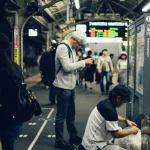
On trains and subways, the standards are firm: phone calls are not made in carriages (step off at the platform), voices stay low, and eating is avoided on most urban trains (long-distance Shinkansen are an exception). Priority seating near the doors is marked clearly and is reserved for elderly passengers, pregnant women, people with disabilities, and those with small children. Even if the carriage is quiet, sitting in priority seating when the person it’s designed for might need it signals poor awareness. On escalators, stand to the left in Tokyo (the right in Osaka) to leave the other side free for those walking.

Queuing is taken seriously everywhere — at train platforms, convenience stores, ramen shops with waiting lines, and even popular park entrances during cherry blossom season. Lines form naturally and are respected. Joining a queue out of order, even accidentally, creates visible discomfort. When waiting for a train, yellow painted floor markings show exactly where to queue; the doors open at those precise spots.
Eating while walking is still considered slightly impolite in most of Japan, though it’s become more tolerated in high-tourist areas. Eating at a dedicated spot near a food stall or sitting down is the cleaner approach. One firm rule: never walk while smoking. Designated smoking areas exist in most cities, and smoking outside them carries both social and, in some municipalities, legal consequences with on-the-spot fines of up to ¥2,000.
Waste bins are rare on Japanese streets — a deliberate policy. Carry a small bag for rubbish and dispose of it at your accommodation or at a convenience store bin (which accepts general small waste). The streets are clean because people carry their own rubbish, not because of frequent bins.
Onsen and Sentō: Bathing Culture Done Right
Public bathing — at an onsen (natural hot spring bath) or sentō (public bathhouse) — is one of the most genuinely Japanese experiences available to visitors, and one of the most etiquette-dense. Getting it right means you actually enjoy it rather than feeling anxious the whole time.
The process: store your shoes in the entrance locker, pay the entry fee, separate into men’s and women’s changing areas, undress completely and store your clothing in a locker, then enter the bathing area with only a small towel (which you don’t put in the water). Before entering any bath, sit at one of the low washing stations and wash your entire body thoroughly with soap and shampoo using the hand shower provided. Rinse completely. Only then do you enter the communal bath. This is the non-negotiable rule — the bath is for soaking in clean bodies, not for washing. Entering without washing first is considered extremely inconsiderate.

Keep your small towel folded on your head or on the side of the bath while you soak. Don’t splash, talk loudly, or bring your phone anywhere near the bathing area. The atmosphere is quiet, contemplative, and often quite wonderful — the mineral-rich water, the steam rising off outdoor rotenburo (open-air baths) against cool air, the specific mineral smell that varies by spring — it’s sensory in a way that’s hard to replicate anywhere else.
On tattoo policies in 2026: the situation has shifted meaningfully. While many traditional onsen facilities still prohibit visible tattoos, a growing number — particularly in urban areas and at newer tourist-oriented facilities — have adopted private bath booking options or have officially revised their policies to welcome tattooed guests. Before booking, check the facility’s current policy directly. The Japan Tourism Agency’s 2025 guidelines encouraged onsen operators to provide at minimum a private bath option, and many have complied. In rural or traditional areas, the original restrictions often remain.
Gift-Giving: The Ritual Matters as Much as the Gift
Gift-giving in Japan is a social institution with its own logic, calendar, and vocabulary. Two main gift-giving seasons — ochugen (mid-year, around July) and oseibo (year-end, December) — govern formal gift exchange, but gifts are also given when visiting someone’s home, returning from travel, or as expressions of gratitude. As a traveller, the most common scenario is bringing omiyage — regional food souvenirs — to people you meet or hosts who’ve helped you.

The presentation of a gift is genuinely important. Gifts are ideally wrapped neatly; Japanese department stores and specialty shops wrap beautifully as standard. If you’re buying omiyage from a shop, the packaging is usually already gift-appropriate. When presenting a gift, offer it with both hands and a slight bow. The phrase tsumaranai mono desu ga (tsu-ma-ra-nai mo-no-des-ga) — “this is a trivial thing, but…” — is a conventional humble preface that signals good manners even if the gift is actually quite nice.
Expect the gift not to be opened in front of you in most traditional contexts. This isn’t indifference — it’s consideration. Opening a gift publicly puts both giver and receiver in a potentially awkward position if the reaction doesn’t match the expectation. The recipient will express appreciation warmly, set the gift aside, and open it privately.
Gifts to avoid: sets of four items (the word for four, shi, sounds like the word for death) and sets of nine (ku sounds like suffering). White flowers, especially chrysanthemums, are associated with funerals. Sharp objects like knives or scissors suggest severing a relationship. None of these rules are enforced rigidly with strangers, but following them shows cultural awareness that goes beyond surface-level tourism.
2026 Budget Reality: The Social Cost of Getting It Wrong
Most etiquette mistakes in Japan carry no financial penalty. Japanese people will rarely tell you directly that you’ve done something wrong — the discomfort tends to be silent, and the consequence is a slightly cooler interaction rather than a confrontation or a bill. That said, a few situations do have real costs in 2026.

- Smoking outside designated areas: On-the-spot fines in cities like Tokyo, Osaka, and Kyoto range from ¥1,000 to ¥2,000, enforced by local wardens. This is actively enforced in tourist-heavy districts.
- Littering: Technically carries fines under municipal ordinances, though enforcement against tourists is rare. The social cost — visible disapproval — is the more immediate consequence.
- Onsen entry without proper washing: You’ll be asked to leave. No refund in most facilities.
- Photography in prohibited zones at temples: You may be asked to delete images by staff. Some major temples (notably Tō-ji in Kyoto and Senso-ji in Asakusa) have become more active about enforcement in 2026 following years of complaints from worshippers.
Investing in etiquette has a positive financial dimension too. Travellers who engage respectfully and show basic cultural literacy often receive genuine generosity from locals — an extra dish at a small restaurant, guidance to a spot not on any map, or simply the kind of warm service that makes a place memorable. That exchange can’t be quantified, but it’s real.
Budget tier summary for common etiquette-related expenses:
- Omiyage (souvenir gifts to give): Budget ¥500–¥1,500 per recipient; mid-range ¥2,000–¥5,000 for quality regional specialties
- Onsen / sentō entry: Public sentō typically ¥500–¥700; standard onsen ¥800–¥1,500; higher-end ryokan onsen access ¥2,000–¥4,000 as a day visitor
- Temple/shrine entry fees: Many are free; paid admission ranges from ¥300–¥1,000; special treasure halls up to ¥1,500
- Incense or offering coins: ¥100–¥500, entirely optional
Frequently Asked Questions
Is it rude to speak English in Japan in 2026?
Not at all. English signage and basic English communication have expanded significantly in major cities and tourist areas following infrastructure investments ahead of recent international events. Speaking English clearly and slowly is fine. Making any effort to use even basic Japanese phrases — sumimasen, arigatou — is genuinely appreciated and shifts most interactions in a warmer direction immediately.

Can I shake hands instead of bowing in Japan?
Yes, in contexts where a Japanese person initiates it or where the situation is clearly international. In traditional or formal Japanese settings, follow the other person’s lead. If they bow, bow back. Many Japanese people in 2026 are comfortable with either, and will often adapt to what they sense you’re comfortable with. Don’t force a handshake if a bow is being offered.
Is it acceptable to take photos of people in Japan without asking?
Generally no — the same courtesy that applies anywhere applies in Japan, and it applies more firmly in religious contexts and at festivals. Photographing someone in prayer at a shrine or temple without permission is considered disrespectful. In busy public spaces, candid street photography exists in a grey zone; if someone indicates discomfort, stop immediately and apologise. Some geisha districts in Kyoto have introduced formal no-photography zones for pedestrians, enforced by local neighbourhood associations.
What should I do if I accidentally make a social mistake in Japan?
Acknowledge it calmly, offer a sincere apology with a small bow, and don’t over-explain or make a performance of your embarrassment. The phrase sumimasen (excuse me / I’m sorry) covers a wide range of situations. Japanese people almost universally give foreign visitors the benefit of the doubt, and a genuine expression of regret resolves most minor incidents immediately.
Are the etiquette rules the same across all of Japan, or do they vary by region?
The core principles — harmony, respect, cleanliness, consideration for others — are consistent nationwide. Regional variations exist in specifics: escalator standing sides differ between Tokyo and Osaka, local festival customs vary significantly, and rural communities tend to hold more traditional expectations than urban centres. In 2026, Tokyo and Osaka remain the most internationally adapted cities; smaller cities and rural areas reward travellers who approach with more formal respect for local norms.
📷 Featured image by Victoriano Izquierdo on Unsplash.