On this page
- How the Cherry Blossom Forecast Actually Works
- 2026 Forecast Overview: What the Data Is Showing
- The Best Regions to Chase Blossoms by Date
- What Full Bloom Actually Looks Like on the Ground
- Hanami Culture: How Japanese People Actually Celebrate
- 2026 Budget Reality: What a Cherry Blossom Trip Costs
- Practical Timing Strategies to Avoid the Crowds
- Beyond the Famous Spots: Lesser-Known Blossom Experiences
- Frequently Asked Questions
Japan‘s cherry blossom season remains one of the most searched travel events in the world, and in 2026, the planning pressure is higher than ever. The post-pandemic tourism surge has not slowed down — if anything, spring crowds at iconic spots like Maruyama Park in Kyoto and Chidorigafuchi in Tokyo are denser than they were in 2019. The window for full bloom is typically just one to two weeks, and missing it by even a few days can mean arriving to half-bare branches or a carpet of fallen petals. This guide gives you the tools to plan smarter, not just earlier.
How the Cherry Blossom Forecast Actually Works
Japan’s sakura forecast is not guesswork. It is built on a combination of historical temperature data, phenological modelling, and real-time meteorological tracking. The Japan Meteorological Corporation and several private forecasting services publish predictions from as early as January each year, updating them weekly as spring approaches.
The core mechanism is something called the 600-degree rule. Scientists track the cumulative daily maximum temperatures from February 1 onward. Once the total reaches approximately 600 degrees Celsius, the cherry trees are expected to bloom. This threshold was developed through decades of observation across Japan’s dominant sakura variety, the Somei Yoshino, which accounts for roughly 80 percent of all cherry trees in Japan.
The Somei Yoshino is a cultivated hybrid — sterile and propagated entirely through grafting — which means every tree across the country is genetically identical. That uniformity is precisely why Japan can produce a single, reliable nationwide forecast. All Somei Yoshino trees respond to temperature in essentially the same way.
There is also a chilling requirement. The trees need a period of cold dormancy in winter before they can bloom in spring. In recent years, unusually warm winters in Kyushu and parts of the Kanto region have occasionally disrupted this cycle, leading to scattered or delayed blooms. Climate scientists tracking Japan’s sakura data have recorded a long-term trend toward earlier blooms — a shift of roughly 10 days over the past 70 years.

The forecast moves in four stages you will see referenced everywhere in Japan during spring:
- Kaika — the opening day, when around 5–10 flowers appear on a benchmark tree
- Sanbuzaki — about 30 percent open
- Mankai — full bloom, around 80 percent or more open (the peak most visitors are chasing)
- Chiri hajime — petals beginning to fall
The gap between kaika and mankai is typically about one to two weeks depending on temperatures. Once mankai is reached, the blossoms usually hold for five to seven days in dry, mild conditions — less if rain or wind hits.
2026 Forecast Overview: What the Data Is Showing
Based on February and early March temperature data, the 2026 cherry blossom season is tracking close to the recent average, with some regional variation. The winter of 2025–2026 brought adequate chilling hours across most of Honshu, which forecasters consider a good sign for a clean, synchronized bloom rather than a patchy one.
Preliminary 2026 forecast dates (subject to revision as conditions develop):
- Tokyo (Kanto): First bloom around late March 20–24, mankai around April 1–5
- Kyoto (Kansai): First bloom around March 25–28, mankai around April 3–7
- Osaka: Slightly ahead of Kyoto — first bloom around March 23–27, mankai April 1–5
- Hiroshima: First bloom late March, mankai around April 1–4
- Sendai (Tohoku): First bloom mid-April, mankai around April 17–22
- Sapporo (Hokkaido): First bloom late April to early May, mankai around April 28 – May 5
Always cross-reference these estimates against real-time updates from the Japan Meteorological Corporation or Weathernews Japan as your travel dates approach. In 2025, a warm late-March spell pushed Tokyo’s mankai nearly four days ahead of the initial forecast, catching many visitors off-guard.

The Best Regions to Chase Blossoms by Date
Japan stretches across roughly 25 degrees of latitude, which creates a natural cherry blossom wave that rolls northward from late March through early May. Understanding this geography lets you plan a multi-stop trip that follows the bloom, dramatically extending your window.
Late March: Kyushu and Western Japan
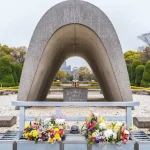
Fukuoka, Nagasaki, and Kumamoto typically see the earliest mainland blooms. Hiroshima’s Peace Memorial Park is one of the most meaningful hanami settings in the country, where hundreds of cherry trees line the banks of the Motoyasu River around late March to early April. The contrast between the park’s history and the delicacy of the blossoms creates an atmosphere that is unlike anywhere else in Japan.
Late March to Early April: Tokyo and the Kanto Region
Tokyo is the most visited sakura destination in Japan. Chidorigafuchi moat, Shinjuku Gyoen National Garden, Ueno Park, and Meguro River are the most famous locations. Shinjuku Gyoen is one of the few spots that bans alcohol, which changes the atmosphere entirely — calmer, more families, more focused on the trees themselves.
Late March to Mid-April: Kansai (Kyoto, Osaka, Nara)
Kyoto’s density of historic backdrops makes it the photographic peak of any sakura trip. Maruyama Park, the Philosopher’s Path, and Kiyomizudera all offer world-class blossom scenery within a few kilometres of each other. Nara’s Yoshino Mountain is famous for its yamazakura (mountain cherry) trees — a different species from Somei Yoshino — which bloom in layers across the hillside from late March through mid-April.

Mid-April: Tohoku
Once Tokyo and Kyoto are past peak, Tohoku blooms. Hirosaki Castle in Aomori Prefecture is consistently ranked among Japan’s top three cherry blossom sites. The castle moat fills with fallen petals creating a phenomenon the Japanese call hanaikada — a raft of flowers on the water. The Tohoku Shinkansen makes Hirosaki accessible from Tokyo in around three hours to Shin-Aomori, then 35 minutes by limited express.
Late April to Early May: Hokkaido
Sapporo’s Maruyama Park and the Goryokaku star-shaped fort in Hakodate are the standout Hokkaido spots. Bloom timing here conveniently overlaps with Japan’s Golden Week holiday period (late April – early May), though that comes with its own crowd considerations.
What Full Bloom Actually Looks Like on the Ground
Reading about cherry blossoms and standing under a fully bloomed Somei Yoshino canopy are two entirely different experiences. At mankai, the branches are so dense with pale white-pink flowers that the sky almost disappears. On a still morning, the petals drift down in slow spirals and settle across every surface — on jackets, in hair, on the surface of park ponds like scattered confetti.
The scent is subtle. Unlike roses or plum blossoms (ume), which preceded the sakura season in February, Somei Yoshino has an almost imperceptible fragrance — faintly sweet, detectable only when you press your face close to a cluster of open flowers. The visual overwhelm is the point.
Walking the Philosopher’s Path in Kyoto at 7:00 in the morning — before the tour groups and the food stalls and the selfie crowds — when the canal runs pink with floating petals and the only sounds are birdsong and the soft crunch of gravel underfoot, is one of those travel experiences that genuinely defies adequate description. That specific window exists. It is real. It just requires showing up before 8:00 AM.

At night, many parks and riverside areas set up illuminations (yozakura) from around 6:00 PM to 10:00 PM during peak bloom. The trees are lit from below, turning the blossoms a warmer, more golden pink against a dark sky. Chidorigafuchi and Meguro River in Tokyo, and Maruyama Park in Kyoto, are particularly well-known for this. The atmosphere at a good yozakura site — lanterns reflecting in the water, crowds moving slowly, vendors selling warm drinks — is distinctly different from the daytime experience and worth the later evening.
Hanami Culture: How Japanese People Actually Celebrate
Hanami (literally “flower viewing”) is one of Japan’s oldest traditions, with records of aristocratic blossom-viewing parties dating to the Nara Period (710–794 CE). Today it is democratic, casual, and deeply embedded in how Japanese people experience the transition from winter to spring.
The modern hanami is essentially a picnic under the cherry trees, usually with friends, colleagues, or family. What makes it culturally distinct from a regular outdoor gathering is the role of the trees themselves — the sakura is not just a backdrop, it is the reason for the gathering, and its brief appearance lends the occasion a particular emotional weight. The Japanese aesthetic concept of mono no aware — a gentle melancholy at the transience of beautiful things — is closely tied to sakura. The blossoms matter precisely because they fall.
At a typical hanami you will see:
- Blue tarps (buru shito) spread under trees to claim spots, sometimes days in advance
- Convenience store bento boxes and onigiri alongside home-cooked food
- Canned beer, canned highballs, sake, and non-alcoholic options — all from nearby konbini
- Sakura-flavoured seasonal foods: sakura mochi (rice cake with salted cherry leaf), sakura latte, sakura Kit Kats
- Groups of office workers with younger employees assigned the early-morning tarp-staking duty

As a visitor, you are entirely welcome to join the tradition. Spread a sheet, buy food from the nearest convenience store, and sit under the trees. There is no entry fee to most public parks. The atmosphere at a well-attended hanami in a public park — the sound of laughter and quiet conversation rippling under the canopy — is the most authentic slice of Japanese social life you will find as a traveller.
A few etiquette points: keep noise reasonable, take all your rubbish home with you (most parks remove bins during hanami season to manage waste), and be aware that some parks restrict or prohibit alcohol entirely.
2026 Budget Reality: What a Cherry Blossom Trip Costs
Spring is Japan’s peak travel season. Accommodation prices spike, and transport to popular destinations books out weeks in advance. Here is an honest breakdown of what to expect in 2026.
Accommodation (per night, per room)
- Budget: Hostel dormitory ¥3,500–¥6,000 / basic business hotel ¥8,000–¥12,000
- Mid-range: Standard hotel in central Tokyo or Kyoto ¥18,000–¥35,000
- Comfortable: Higher-end hotels in sakura-adjacent locations ¥40,000–¥80,000+
Note: Kyoto accommodation during peak bloom (late March – first week of April) has been running 30–50 percent higher than off-season prices since 2024. Book at least three months in advance.
Transport
- Japan Rail Pass (7-day, Ordinary): ¥50,000 in 2026 — worth it if you are moving between Tokyo, Kyoto, and beyond
- Tokyo–Kyoto Shinkansen (one way, unreserved): ¥13,320
- IC card top-up for local travel: Budget ¥500–¥1,500 per day depending on city
Daily Expenses
- Budget traveller: ¥5,000–¥8,000 per day (konbini meals, free park entry, cheap izakaya)
- Mid-range: ¥12,000–¥20,000 per day (sit-down restaurants, paid garden entries, one activity)
- Comfortable: ¥25,000–¥50,000+ per day (kaiseki dinner, private experiences, taxi use)
Garden entry fees are worth highlighting. Shinjuku Gyoen charges ¥500 per adult. Kenrokuen in Kanazawa (excellent for blossom season) charges ¥320 in winter, rising to ¥410 in peak season. Most city parks — Ueno, Maruyama, Hirosaki Castle grounds — are free to enter, though Hirosaki Castle’s innermost enclosure charges ¥320.

Practical Timing Strategies to Avoid the Crowds
The crowds at peak sakura season are not a minor inconvenience — at Arashiyama bamboo grove or the Philosopher’s Path on a Saturday at 11:00 AM in early April, they are genuinely wall-to-wall. These strategies make a measurable difference.
Use the Weekday Advantage
Japanese domestic tourism peaks on weekends, especially during cherry blossom season. If your schedule allows any flexibility, target Tuesday through Thursday for visits to the most popular spots. The difference in crowd density on a Wednesday morning versus a Saturday afternoon can be dramatic.
Go Early or Go Late
The magic hours are before 8:30 AM and after 7:00 PM. Most tour groups are not operational at those hours. Many popular sakura parks open at 5:00 or 6:00 AM — Shinjuku Gyoen opens at 9:00 AM, which is a limitation, but many other parks have no formal opening hours at all.
Target the Day Before Mankai
Paradoxically, arriving when the forecast says a location is at 70–80 percent bloom rather than 100 percent full mankai can give you a better experience. The trees are still spectacular, the crowds have not yet peaked, and you have a buffer if the weather is better the following day.
Consider Lesser-Visited Cities
Kanazawa, Matsumoto, Himeji, and Tsuruga all have excellent sakura sites with a fraction of the crowds found in Tokyo or Kyoto. Himeji Castle with cherry blossoms in the foreground is one of the iconic Japan images — and in 2026, Himeji remains significantly less congested than Kyoto during peak bloom.
Beyond the Famous Spots: Lesser-Known Blossom Experiences
If you have already done the classic itinerary or you want to find something genuinely different, Japan offers cherry blossom experiences that most first-time visitors never find.

Yamazakura and Mountain Cherries
The Somei Yoshino dominates Japan’s sakura calendar, but there are over 600 cultivated varieties of cherry tree in the country. Yamazakura (mountain cherry) has white flowers with bronze-red new leaves appearing simultaneously, creating a completely different visual effect. Yoshino Mountain in Nara Prefecture has around 30,000 yamazakura trees across multiple ridges — they bloom in sequence over two to three weeks, providing a longer viewing window than Somei Yoshino.
Shidare Zakura (Weeping Cherry)
Shidare zakura — weeping cherry trees — have drooping branches that cascade downward like a curtain of blossoms. Maruyama Park in Kyoto has a particularly famous illuminated weeping cherry at its centre. The Miharu Takizakura in Fukushima Prefecture is one of Japan’s three most celebrated cherry trees: a 1,000-year-old weeping cherry that draws visitors from across the country. It blooms in mid-April.
Sakura Alongside Other Landscapes
Some of the most striking sakura scenery comes from combinations: cherry blossoms reflected in castle moats, against snowy mountain backdrops, or along narrow rural train lines where a single-carriage local train passes under overhanging branches. The Tsugaru Railway in Aomori runs a “flower train” during peak bloom, and the Takeda Castle ruins in Hyogo Prefecture are sometimes visible above a sea of cloud with cherry trees in the foreground — though this atmospheric fog phenomenon depends heavily on morning conditions and is never guaranteed.
Shibazakura: The Pink Moss Fields
Slightly later than the main sakura season — typically late April to mid-May — shibazakura (moss phlox) carpets entire hillsides in vivid pink and white. The Fuji Shibazakura Festival at the foot of Mount Fuji in Yamanashi Prefecture is one of the most visually striking events in the entire Japanese spring calendar, and because it does not compete directly with the main sakura peak, the crowds are more manageable.

Frequently Asked Questions
When is the best time to visit Japan for cherry blossoms?
For most of Honshu — including Tokyo and Kyoto — late March to early April is the target window. If you want to follow the bloom north, Tohoku peaks in mid-April and Hokkaido in late April to early May. In 2026, Tokyo mankai is forecast around April 1–5, and Kyoto around April 3–7, but these estimates shift as temperatures change closer to the date.
How long do cherry blossoms last in Japan?
A single location is typically at full bloom for five to seven days under calm, dry weather conditions. Rain or strong wind can shorten this significantly. The national sakura season runs from late March in western Kyushu through to early May in Hokkaido, so the total country-wide window is about six weeks — useful if you have a flexible itinerary and can move northward with the bloom.
Do I need to book cherry blossom festival tickets in advance?
Most public park hanami is free with no tickets required. Some paid gardens like Shinjuku Gyoen (¥500) and Kenrokuen have introduced online pre-booking options in 2026 to manage entry numbers during peak periods. Specific illumination events and festival programmes at certain shrines may require tickets — check individual event websites. For accommodation and Shinkansen reservations, booking three months ahead is strongly recommended.
What is the difference between kaika and mankai?
Kaika is the official “opening day” when roughly 5–10 flowers appear on a benchmark tree designated by the Japan Meteorological Corporation. This signals the start of the bloom but the trees are nowhere near full. Mankai is full bloom — around 80 percent or more of flowers open. The gap between them is typically one to two weeks depending on temperatures after opening day.
Can I do hanami as a tourist, or is it a locals-only tradition?
Hanami is completely open to visitors. Spread a picnic sheet in any public park, buy food from the nearest convenience store, and enjoy the trees alongside Japanese families and friends. There is no barrier to participation. The only etiquette to remember: take all rubbish with you when you leave, keep noise at a reasonable level, and check whether the specific park permits alcohol before cracking open a can.
📷 Featured image by Daniel Beauchamp on Unsplash.