On this page
- How Japan’s Payment Mix Works in 2026
- What a Travel Money Card Actually Does
- Wise vs Revolut vs Other Cards: The Numbers
- Step-by-Step: Getting Yen From a Japanese ATM
- 2026 Budget Reality: What the Fees Cost in Yen
- Tax-Free Shopping and the No-Tipping Rule
- Common Mistakes to Avoid
- The Verdict: Who Should Get One
- Frequently Asked Questions
💰 Click here to see Japan Budget Breakdown
💰 Prices updated: November, 2026. Budget figures are estimates — always verify before travel.
Exchange Rate: $1 USD = ¥157.56
Daily Budget (per person)
Shoestring: ¥7,000 – ¥12,000 ($44.43 – $76.16)
Mid-range: ¥15,000 – ¥25,000 ($95.20 – $158.67)
Comfortable: ¥30,000 – ¥75,000 ($190.40 – $476.01)
Accommodation (per night)
Hostel/guesthouse: ¥2,500 – ¥7,750 ($15.87 – $49.19)
Mid-range hotel: ¥5,000 – ¥18,500 ($31.73 – $117.42)
Food (per meal)
Budget meal: ¥800.00 ($5.08)
Mid-range meal: ¥2,500.00 ($15.87)
Upscale meal: ¥10,000.00 ($63.47)
Transport
Single metro/bus trip: ¥250.00 ($1.59)
Monthly transport pass: ¥53,000.00 ($336.38)
You have probably seen the advice online: “Japan is cash-only,” then “Japan is fully cashless now.” Both are wrong, and the confusion leads people to buy a travel money card they do not need, or skip one that would save them real money. In 2026, Japan sits in the middle. Card payments keep growing, but plenty of small shops, shrines and rural businesses still want yen in your hand. This guide shows where a travel money card fits, what it costs, and who should skip it.
How Japan’s Payment Mix Works in 2026
Before judging any card, you need to know what you will be paying with. Most visitors end up using three tools side by side: cash, an IC card and a credit or debit card.
Yen cash: still essential
Cash is less dominant than it used to be, but you still need it. Many independent restaurants, cafes, souvenir shops and local markets stay cash-only, especially outside big city centres. Temples and shrines usually want coins for entrance fees, omikuji (paper fortunes) and small offerings. Some smaller ryokan (traditional inns) prefer cash for the final bill or extras. In rural areas, cash is still the default.
A sensible float is 10,000 JPY to 30,000 JPY, depending on how you plan to spend. Top it up at ATMs as you go.
IC cards: for trains and small purchases
IC cards include Suica (JR East), PASMO (Tokyo Metro and private railways), Icoca (JR West), Kitaca (JR Hokkaido), Toica (JR Central), Manaca (Nagoya), Sugoca (JR Kyushu), Nimoca and Hayakaken (Fukuoka), and PiTaPa (Kansai, post-paid and less common for tourists). They work across Japan for transit. You tap in and tap out on trains, subways, buses and streetcars.
They also work at konbini like 7-Eleven, Lawson and FamilyMart, at many vending machines, at station coin lockers, and at a growing number of chain restaurants and kiosks. That small-purchase role is why a travel money card does not replace an IC card.
For tourists in 2026, the best option is a digital card: Mobile Suica or Mobile PASMO. You add it to Apple Wallet (iPhone 8 or newer, Apple Watch Series 3 or newer) or Google Wallet on Android phones that support Osaifu-Keitai. Some international Android phones have problems, so check your model before you fly. You top up inside the Wallet app with a linked Visa, Mastercard, Amex or JCB card. No ATM visit, no queue, no deposit.
If you prefer a physical card, Welcome Suica and PASMO Passport are sold at major stations such as Narita, Haneda and big Tokyo stations. They carry no deposit, are valid for 28 days, cannot be refunded, and hold a maximum of 20,000 JPY. A standard Suica or PASMO needs a 500 JPY deposit, refundable when you return the card (minus a 220 JPY handling fee if there is still a balance). Official pages: https://www.jreast.co.jp/e/suica/ and https://www.pasmo.co.jp/en/.

Credit and debit cards: for the bigger spending
Visa, Mastercard and JCB are the most widely accepted. American Express and Diners Club work at many major places, and UnionPay acceptance has grown a lot. Cards are universal at major hotels and department stores. They are common at larger restaurants and chains, electronics stores like Bic Camera and Yodobashi Camera, JR stations for Shinkansen tickets, and konbini. Most taxis in major cities take cards too. Look for the sticker on the window.
Cards often do not work at small independent restaurants and cafes, minshuku (family-run guesthouses), some small souvenir shops, and rural businesses. Contactless tap-to-pay is now normal at most terminals, so look for the contactless symbol.
What a Travel Money Card Actually Does
A travel money card is a prepaid debit card. You load money onto it, either in your home currency to convert to yen in the app, or in yen directly. It works anywhere that accepts Visa or Mastercard debit.
What it does well:
- Rate certainty: you can lock in an exchange rate when you load yen.
- Security: it is not linked to your main bank account, so a lost or stolen card exposes only what you loaded.
- Budgeting: you pre-allocate a fixed amount and stop when it is gone.
What it does not do well:
- Some cards charge loading fees.
- ATM withdrawals can stack your provider’s fee on top of the Japanese ATM fee.
- Exchange rate spreads vary. Some are close to the interbank rate, others are not.
- It is not a credit card, so it cannot cover hotel deposits or car rentals that need a credit card hold.
Wise vs Revolut vs Other Cards: The Numbers
These are 2026 estimates based on current offerings. Always check the live fee page for your country before you rely on them.
Wise debit card
Wise is a multi-currency card that holds more than 50 currencies, including JPY. It converts at the mid-market rate with a small, transparent fee (for example, 0.6% for JPY conversion).

- Free ATM limit: up to 30,000 JPY (or equivalent) across 2 withdrawals per calendar month.
- After the limit: 1.75% of the amount plus 70 JPY per withdrawal.
- Japanese ATM fee: expect another 220 JPY per transaction from the operator, such as Seven Bank.
- Card payments: free if you hold yen in your account. If not, it converts from another currency at the mid-market rate plus the conversion fee.
You manage everything in the Wise app (iOS and Android). Site: https://wise.com/.
Revolut debit card
Revolut has tiered plans (Standard, Plus, Premium, Metal). It exchanges currencies, including JPY, often at interbank rates, with weekend markups.
- Free ATM limit (Standard plan): up to 25,000 JPY (or equivalent) per month.
- After the limit: 2% of the amount.
- Japanese ATM fee: another 220 JPY per transaction.
- Card payments: free for most currencies on weekdays within monthly limits. A weekend markup (for example, 1%) applies.
Revolut changes plan features often, so read the 2026 terms for your region at https://www.revolut.com/.
Travelex, Post Office Travel Money and regional bank cards
These tend to have weaker exchange rates or higher fees than Wise or Revolut. Compare loading fees, ATM fees and inactivity fees closely. Competition has pushed some providers to improve, but they still often trail the digital-first options.
Step-by-Step: Getting Yen From a Japanese ATM
Standing at a konbini ATM at 11 p.m., with the fluorescent glow of the shop behind you and a screen full of Japanese, is where a lot of visitors panic. The process is simple once you know the order. The most reliable machines are the Seven Bank ATMs inside 7-Eleven stores, open 24/7. Lawson (Loppi ATMs), FamilyMart (E-net ATMs) and Japan Post Bank (JP Bank) ATMs in post offices also work. JP Bank may have slightly different fees or hours for foreign cards.
- Insert your card.
- Select “International Cards” (or similar) and switch to English if needed.
- Choose “Withdrawal.” Choose “Cash Advance” if it is a credit card.
- Select “Savings Account,” or “Checking Account” if offered. This applies even to a prepaid card.
- Enter your PIN.
- Enter the amount in JPY.
- Confirm the fee. The local ATM fee will appear on screen.
- Collect your cash and your card.
Seven Bank, Lawson and FamilyMart ATMs typically charge 220 JPY per transaction for foreign cards. The limit per transaction is typically 100,000 JPY. Daily limits depend on your card issuer, usually between 50,000 JPY and 200,000 JPY.
2026 Budget Reality: What the Fees Cost in Yen
Here is how the fees compare in yen, using the figures above. The examples show how fast percentages add up.
What a 50,000 JPY ATM withdrawal can cost
- Home bank charging 500 JPY + 3%: 1,500 JPY + 500 JPY + 220 JPY local fee = about 2,220 JPY.
- Wise, beyond the free limit: 1.75% (875 JPY) + 70 JPY + 220 JPY = about 1,165 JPY.
- Revolut Standard, beyond the free limit: 2% (1,000 JPY) + 220 JPY = about 1,220 JPY.
- Within the free limits: you pay only the 220 JPY local fee.
What card payments cost on 100,000 JPY of spending
- Card with 2% to 3% foreign transaction fee: about 2,000 JPY to 3,000 JPY.
- Wise at 0.6% conversion: about 600 JPY.
- Card with 0% foreign transaction fee: 0 JPY.
The takeaway is that a travel money card only wins if your current card is expensive. If you already have a 0% card, the travel money card has nothing to beat.
Tax-Free Shopping and the No-Tipping Rule
Two money rules matter as much as card fees: you can save on purchases, and you never need to tip.
Tax-free shopping
If you are a non-resident visiting for less than 6 months, you can shop tax-free at stores showing the “Tax-Free” logo, often department stores, large electronics retailers and drugstores. The details:
- General goods (electronics, clothing, crafts): 5,000 JPY or more, excluding tax, at one store on one day.
- Consumables (food, cosmetics, medicine): 5,000 JPY to 500,000 JPY, excluding tax, at one store on one day.
- Combined: you can combine general goods and consumables at the same store on the same day to reach the minimum. Consumables go in a special sealed bag and must stay unopened until you leave Japan.
Show your physical passport, not a copy or a photo, at the tax-free counter or at checkout. The store either deducts the tax immediately or gives a refund. Your purchase is recorded digitally against your passport, and you must leave Japan with the items.
No tipping
Japan has no tipping culture. Do not tip at restaurants, hotels, taxis or on tours. It can confuse staff or come across as rude, because good service is already the standard. A warm “arigato gozaimasu” is enough. That means your travel money does not need a tipping buffer.

Common Mistakes to Avoid
- Accepting DCC. If a terminal offers to charge you in your home currency, decline and pay in JPY. Dynamic Currency Conversion usually means a worse rate and hidden fees.
- Relying on one card only. A prepaid card is not a credit card. It cannot cover hotel deposits or car rental holds. Bring a proper credit card too.
- Arriving with no yen. Many small family-run restaurants in quiet towns are cash-only, and you do not want to be hunting for an ATM then.
- Using Wise or Revolut for repeated small withdrawals. Each one adds 220 JPY, and after your free limit the provider’s own fees apply too.
- Forgetting to check phone compatibility. Some international Android phones have issues with Osaifu-Keitai, so do not assume Mobile Suica or PASMO will work. Test your setup before departure.
- Buying a physical Welcome Suica expecting a refund. Tourist cards last about 28 days and cannot be refunded. The 20,000 JPY maximum balance also applies.
- Opening tax-free consumables before leaving Japan. The sealed bag must stay unopened until you depart.
- Trusting old fee numbers. Wise and Revolut limits and fees can change. Check live terms before you travel.
The Verdict: Who Should Get One
A travel money card is worth it if:
- Your regular cards charge 2% to 3% or more in foreign transaction fees.
- Your home bank charges heavy ATM fees (for example, 500 JPY + 3%), and a free Wise or Revolut limit would cut that.
- You want a separate, pre-loaded pot of money for budgeting and security.
- You want to lock in a favourable yen rate in advance.
It is probably not necessary if:
- You already hold a credit or debit card with 0% foreign transaction fees and good exchange rates.
- You mainly plan to use cash and an IC card, and a credit card only for big expenses.
- You expect only one or two ATM withdrawals.
For most travellers in 2026, the practical setup is four layers. Carry JPY cash for small businesses, temples and rural areas. Add a Mobile Suica or PASMO for transit and konbini. Use a no-foreign-fee credit or debit card for hotels, department stores and larger restaurants, tapping contactless. Then treat Wise or Revolut as a supplement, used within its free ATM limits or for card payments when its rates beat your main card. Compare the fees on your existing cards first, and you will know quickly whether a travel money card is worth the effort.

Frequently Asked Questions
Do I need a travel money card for Japan?
Not necessarily. It helps if your regular cards charge 2% to 3% foreign transaction fees or heavy ATM fees. If you already have a card with no foreign transaction fees, plus some yen cash and a Mobile Suica or PASMO, a travel money card is usually redundant.
Is Wise or Revolut better for Japan?
Wise uses the mid-market rate with a small fee, around 0.6% for JPY, and offers up to 30,000 JPY free across two ATM withdrawals monthly. Revolut Standard offers up to 25,000 JPY free but adds weekend markups. Both estimates can change, so check current terms.
How much does it cost to withdraw cash in Japan with a foreign card?
Seven Bank, Lawson and FamilyMart ATMs typically charge 220 JPY per transaction for foreign cards. Your own bank or card provider may add a fixed fee, a percentage, or both. The per-transaction limit is typically 100,000 JPY, and daily limits depend on your issuer.
Can I use a travel money card for hotels and car rentals?
Usually not for deposits. A travel money card works like a debit card and is not a credit card, so it may be refused for hotel deposits or car rentals that need a credit card hold. Carry a proper credit card for those bookings.
Should I tip in Japan?
No. Japan has no tipping culture, and tipping can confuse or even offend people because excellent service is standard. Do not tip restaurant staff, taxi drivers, hotel staff or tour guides. A simple “arigato gozaimasu” (thank you very much) is the right way to show appreciation.
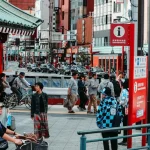
📷 Featured image by Michel Catalisano on Unsplash.