On this page
- How the Tokyo Subway System Is Actually Structured
- Buying the Right Ticket or Pass for Your Trip
- Reading the Signs and Platforms Without Panic
- Rush Hour Reality and When to Actually Travel
- Transfers, Exits, and Not Getting Lost Underground
- 2026 Budget Reality: What Riding the Subway Actually Costs
- Frequently Asked Questions
Tokyo‘s subway intimidates even experienced travellers. With 13 metro lines, two separate operators, and over 280 stations in the central network alone, the first time you step onto a platform at Shinjuku Station — the busiest station in the world — the noise, the crowds, and the wall of coloured lines on the map overhead can feel genuinely overwhelming. In 2026, the system has become slightly more tourist-friendly with expanded English signage and updated IC card interoperability, but the fundamental complexity remains. This guide cuts through it.
How the Tokyo Subway System Is Actually Structured
The first thing to understand: “Tokyo subway” is not one thing. It is two separate companies operating side by side, and you need to know the difference because it affects your tickets and passes.
Tokyo Metro operates 9 lines and is the network most tourists use the most. These are the Ginza, Marunouchi, Hibiya, Tozai, Chiyoda, Yurakucho, Hanzomon, Namboku, and Fukutoshin lines. Toei Subway is run by the Tokyo Metropolitan Government and operates 4 lines: the Asakusa, Mita, Shinjuku, and Oedo lines.
On top of these, you will frequently use JR East lines — particularly the JR Yamanote Line, which loops around the city connecting major hubs like Shibuya, Shinjuku, Harajuku, Akihabara, and Tokyo Station. JR is technically not the subway, but in practice tourists treat it as part of the same network.
Then there are private railway operators: Tokyu, Keio, Odakyu, Seibu, and others. These connect the suburbs to the city centre and their trains often run directly into Metro stations through a system called through-service, where a train from one operator continues onto another operator’s tracks without passengers needing to change. This is convenient when it works in your favour and confusing when you don’t expect it.
The practical upshot: a single journey across Tokyo might cross two or three operators, and unless you are using an IC card, you will need separate tickets for each.
Buying the Right Ticket or Pass for Your Trip
For most tourists, the answer is simple: get a Suica or Pasmo IC card the moment you arrive. These rechargeable contactless cards work across virtually every train, subway, and bus in Tokyo regardless of operator. They also work at convenience stores, vending machines, and many restaurants. In 2026, both cards are available as digital versions on compatible smartphones, which is the preferred option since the physical card shortage that began in 2023 has still not been fully resolved — physical cards remain limited at some stations.

Load ¥3,000–¥5,000 to start. The system automatically deducts the correct fare when you tap in and tap out, handling multi-operator journeys seamlessly behind the scenes.
If you plan to travel extensively by subway for several days, dedicated tourist passes can save money:
- Tokyo Metro 24/48/72-hour passes: Unlimited travel on all 9 Tokyo Metro lines. Priced at ¥800 / ¥1,200 / ¥1,500 in 2026. Good value if you are staying in central Tokyo and riding frequently.
- Tokyo Subway Ticket: Covers both Tokyo Metro and Toei Subway lines. Available in 24/48/72-hour versions at ¥1,000 / ¥1,400 / ¥1,700. Sold at major stations and the Tourist Information Center at Narita and Haneda airports. Requires proof of foreign passport.
- JR Pass: Covers JR lines including the Yamanote Line, but does NOT cover Tokyo Metro or Toei lines. Useful for long-distance Shinkansen travel but not a city subway solution on its own. In 2026, the 7-day JR Pass is priced at ¥50,000 for ordinary class.
Do the math before buying any pass. If you are only making 2–3 trips a day, paying per ride with an IC card will likely be cheaper.
Reading the Signs and Platforms Without Panic
Tokyo’s stations have improved enormously in the past five years. Every station on the Metro and Toei networks now displays station names in English on platform signs, overhead displays, and inside train carriages. Announcements are made in both Japanese and English on all Metro lines.
The key to reading the system quickly is the station numbering system. Every station has a letter-number code. The letter identifies the line, the number identifies the station. For example, Shibuya on the Ginza Line is G-01. Aoyama-itchome is G-02. You always know which direction you are heading — lower numbers go one way, higher numbers go the other. This means even if you cannot read Japanese at all, you can navigate by watching the numbers.
Each line also has its own colour. The Ginza Line is orange. The Marunouchi Line is red. The Yamanote Line is green. On platform signs, maps, and train exteriors, these colours are consistent. When you walk into a station, look for the coloured circle with the line letter and station number — that anchors you immediately.

Platform screens inside the trains show the next station, the current station, and which side the doors will open. At larger stations like Shinjuku or Ikebukuro, numbered exit signs are displayed inside the carriage before arrival — a small but genuinely useful detail when you need a specific exit in a station with 50-plus exits.
Rush Hour Reality and When to Actually Travel
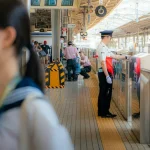
Tokyo rush hour is not a myth. Between 07:30 and 09:30 on weekday mornings, and 17:30 and 20:00 in the evenings, trains on central lines reach 180–200% capacity. Platform staff in white gloves physically push passengers into carriages at stations like Shinjuku and Shibuya. Standing in a packed Yamanote Line train, pressed against the door glass with your bag wedged between strangers and the smell of rain-damp coats filling the carriage, is an authentic Tokyo experience — but not a pleasant one if you are carrying luggage or are claustrophobic.
Practical solutions: schedule museum visits, temple walks, or neighbourhood exploration during morning rush, and use the subway to travel before 07:00 or between 10:00 and 17:00. Tokyo is a city where being an early riser rewards you. The streets around Senso-ji in Asakusa at 06:30, lit by the soft amber glow of the lanterns before the tourist groups arrive, feel like a completely different city than the same street at noon.
On most Tokyo Metro trains, the priority seats near the doors are reserved for elderly passengers, pregnant passengers, and those with disabilities. On some lines during rush hour, the carriage nearest the women-only car signage is designated women-only during morning peak hours. These are clearly marked and tourists are expected to follow the same rules as everyone else.
Transfers, Exits, and Not Getting Lost Underground
Transferring between lines — especially between Tokyo Metro and Toei, or between Metro and JR — requires walking through sometimes long underground corridors. At Shinjuku, the underground walkway between the JR gates and the Metro platforms is nearly 500 metres. At Otemachi, four separate lines intersect and the transfer routes can take 10 minutes on foot.
When using an IC card, transfers between operators within a set time window are handled automatically with a calculated combined fare. You do not need to exit and re-enter through separate gates as long as the stations are connected underground — the system detects the transfer. If you exit through a gate entirely (stepping outside), the system closes the journey and you start a new one, which can cost more.

Exits are numbered and often named. In a city like Tokyo where a single station can have 60 exits, knowing your exit number before you arrive matters enormously. Google Maps and Apple Maps both show you which exit number to use for your destination — follow their exit recommendation, not just the station name. The difference between Exit A1 and Exit B3 at Shinjuku can put you 800 metres apart on street level.
One underused tool: the station staff offices (marked with a blue “i” sign or simply labelled “Station Staff”) at every major station. Staff speak enough English to answer basic questions, and they carry printed English-language maps of complex station layouts. At Shinjuku, these layout maps are genuinely indispensable the first time.
2026 Budget Reality: What Riding the Subway Actually Costs
Tokyo’s subway fares are distance-based and operator-specific, but the ranges are predictable once you know the network.
- Budget (short hops, 1–3 stations): ¥170–¥200 per trip. A journey like Shinjuku to Yoyogi on the Oedo Line or Ueno to Akihabara on the Hibiya Line falls in this range.
- Mid-range (cross-city journeys, 4–8 stations): ¥220–¥310 per trip. Shibuya to Asakusa on the Ginza Line, for example, costs around ¥280.
- Longer journeys or multi-operator trips: ¥350–¥500+. Crossing from the far west of the city to the east, or combining Metro and JR segments, can reach ¥450–¥500.
A realistic daily transport budget for a tourist actively sightseeing across different neighbourhoods: ¥1,200–¥2,000 per day using pay-as-you-go IC card. A tourist pass makes sense if you plan to exceed ¥1,500 in Metro-only travel on a given day.
Children aged 6–11 pay half fare. Children under 6 travel free when accompanied by an adult. These discounts apply automatically when children tap a child-registered IC card, or at ticket machines with a children’s fare button.
IC cards require a ¥500 deposit (refundable when you return the card at the end of your trip). Digital IC cards have no deposit.
Frequently Asked Questions
Can I use a credit card directly at subway gates in Tokyo?
As of 2026, most Tokyo Metro and Toei station gates do not accept credit cards directly at the turnstile. You need either an IC card (physical or digital) or a paper ticket purchased at a machine. Some newer stations are piloting contactless credit card entry, but this is not yet reliable system-wide. Stick with a Suica or Pasmo IC card for smooth travel.

Is the Tokyo subway safe late at night?
Extremely safe by global standards. Trains run until around midnight on most lines, and platforms and carriages are well-lit and monitored. The main practical issue is not safety — it is timing. If you miss the last train, taxis in Tokyo are expensive (¥1,000 for the first 1.2 km), and ride-share services like Uber exist but have limited availability in some areas.
Do I need to speak Japanese to use the subway?
No. Station signage, ticket machines, and in-train displays all operate in English throughout the network. Ticket machines have a clear English-language button. Google Maps and Apple Maps give accurate real-time directions in English including platform numbers, exit numbers, and transfer instructions. Basic navigation requires no Japanese knowledge at all.
What is the difference between a Suica and a Pasmo card?
Functionally, almost none for tourists in Tokyo. Both work on the same trains, buses, and at the same stores. Suica is issued by JR East; Pasmo is issued by the private railway consortium. Use whichever is available when you arrive, or set up either one digitally before departure. They are fully interchangeable for transport use across Japan.
Can I bring large luggage on the Tokyo subway?
There is no outright ban, but large suitcases during rush hour are strongly discouraged and genuinely difficult to manage. Most tourists travelling with large bags use direct bus or train connections from airports to their hotel area. If you must take the subway with luggage, travel outside peak hours and choose end carriages where there is slightly more space near the doors.
Explore more
First Time in Tokyo? Your Perfect 7-Day Itinerary & Travel Guide
Shinjuku Nightlife: Where to Find the Best Bars, Clubs & Golden Gai
Where Should First-Timers Eat in Tokyo? Your Essential Guide